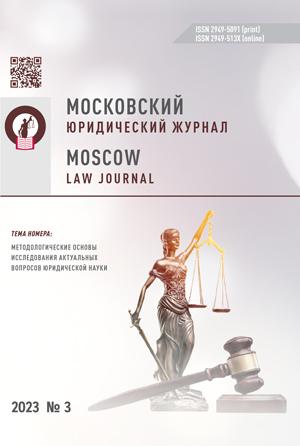
The edition is published 4 times a year. The journal “Moscow Juridical Journal” is included into the list of Higher Certifying Commission (НСС) in four specialities of Jurisprudence: 5.1.1. Theoretical-Historical Legal sciences (Jurisprudence), 5.1.2. Public Law (State Law) sciences (Jurisprudence), 5.1.3. Private Law (Civilistic) sciences (Jurisprudence), 5.1.4. Criminal Law sciences (Jurisprudence).
The printed journal publishes the articles of Russian and foreign scientists devoted to vital theoretical and practical problems of jurisprudence of Russia and foreign countries. Thus the editorial board and editorial council, firstly, create the opportunity for scientists and legal experts to exchange opinions; secondly, they strive to ensure the journal’s timely response to relevant law problems arising in practice.
The journal also covers scientific events, book reviews, information about personals and has a rubric “Rostrum for Young Scientists”.
The journal and law universities actively organize “round tables” and conferences.
The journal is addressed to scientists, lecturers, post-graduate students, doctoral candidates, employees of law enforcement bodies, judges, legal advisers, as well as to heads and specialists of bodies of state administration and local self-government.
Current issue
THEORETICAL AND HISTORICAL LEGAL SCIENCES
Aim. To identify the relationship between various human rights protection mechanisms and their features in terms of their functioning and further development.
Methodology. Great attention is paid to the peculiarities of the mechanism of human rights protection of various types, the dynamics of their development and improvement, the influence of information and telecommunication technologies on them.
Results. The types of human rights protection mechanisms and their features are clearly formulated. Considering the action of human rights protection mechanisms, the authors show the tasks solved in the process of implementing such mechanisms, and indicate the priority of developing preventive human rights protection mechanisms based on information and telecommunication technologies.
Research implications. The results obtained are intended to contribute to the study of human rights protection mechanisms and their types. The features of the traditional type of human rights protection mechanism and the preventive human rights protection mechanism are considered. The effectiveness of the specified human rights protection mechanisms is assessed. The need for priority development of preventive human rights protection mechanisms is substantiated, primarily due to the fact that the traditional type of human rights protection mechanism has already reached its peak and the widespread introduction of information and telecommunication technologies into state and legal practice.
PUBLIC LAW (STATE LAW) SCIENCES
Aim. To characterize the concept of corporate social responsibility which unites within itself two other key concepts – environmental responsibility and the social responsibility of business entities. To conduct an analytical review of scientific publications that discuss the practical implementation of ESG principles. To reveal the principles underlying the concept of corporate social responsibility.
Methodology. General scientific and legal methods of scientific inquiry were used.
Results. It is substantiated both that responsible business conduct has a positive impact on environmental safety and emphasizes that implementing ESG principles in business conduct ensures the development of green entrepreneurship. It is concluded that enhancing the environmental and social responsibility of businesses is possible with the successful implementation of an environmental and economic mechanism that ensures sustainable natural resource management.
Research implications. The results of the study can be applied in planning economic (business) and other activities related to environmental impacts.
Aim. To analyze Spain’s experience of regulating citizenship through memorial laws or laws devoted to preservation and protection of historical memory to identify current trends in the institution of citizenship and its substitutes.
Methodology. The key research method was the formal legal approach, which made it possible for the author to analyze the citizenship norms enshrined in memorial laws and other Spanish legal acts in their original languages. For example, the author has compared approaches to the interpretation of the subinstitution of option in Spain and Russia, identifying its characteristics inherent to the Spanish tradition, using a comparative legal approach. The article presents the views of Russian researchers on the nature of memorial laws and international scholars on the characteristic features of the sub-institutions of citizenship: option and the issuance of a naturalization certificate.
Results. Using the results obtained through analysis of Spain’s experience the author concludes that with the adoption of memorial laws, the sub-institution of option, traditionally viewed in Spanish doctrine as a means of acquiring acquired citizenship, is now being transformed into a method of acquiring citizenship by birth. In turn, the sub-institution for issuing a naturalization certificate, rather than being a simple, simplified method for admitting foreigners to the country’s citizenship, is becoming a multifunctional and interdisciplinary sub-institution capable of addressing not only public law but also social issues.
Research implications. The experience of Spain in regulating the issues of granting citizenship by memorial laws is disclosed.
Aim. To determine the legal nature of the destruction of agricultural products imported from countries that have imposed economic sanctions on Russian individuals and legal entities.
Methodology. An analysis of the legal means to apply this measure has been carried out, the stages of its implementation have been studied, and its place in the system of state coercion measures has been determined.
Results. The analysis has shown that the destruction of sanctioned goods is a measure of suppression of the offense, it is provided for in Article 16.3 of the Code of Administrative Offenses and it has its own procedure and mechanism of implementation.
Research implications. The theoretical significance consists in the generalization and systematization of knowledge about the destruction of agricultural goods prohibited for importation into the country. The practical significance lies in the possibility of applying the results to further study the institution of administrative coercion and administrative restraint in particular.
Aim. To analyze approaches of scientists and practitioners in the field of reproductive rights, identification of the legal nature of these rights and the limits of constitutional legal protection in the Russian Federation through the prism of modern practice of the Constitutional Court of the Russian Federation.
Methodology. The main method of scientific research was the formal-legal method, which was used to analyze the provisions of existing legal acts on the consolidation and implementation of human reproductive rights, as well as the judicial practice of their application. General scientific methods: the method of analysis, generalization, the logical method, etc., were also used in the study.
Results. The study made it possible to formulate provisions regarding the legal nature of reproductive rights, the specifics of their implementation and protection, based on the practice of the Constitutional Court of the Russian Federation.
Research implication. The results of the study can be useful for further research on reproductive rights and freedoms, as well as for law enforcement agencies.
PRIVATE LAW (CIVILISTIC) SCIENCES
Aim. To analyze legal problems arising from the introduction of artificial intelligence in property management and to develop proposals for their solution in the context of rapid digitalization of this sphere.
Methodology. A study of foreign experience in regulating artificial intelligence in countries of the Romano-Germanic, Anglo-Saxon and traditional legal systems was conducted. As a result of the analysis of regulatory legal acts and judicial practice, gaps in Russian legislation were identified. An assessment of the ethical and social consequences of automation of real estate management was carried out. When disclosing the research material, analysis, synthesis, induction and deduction were used in the work. In order to develop measures to improve legal regulation, comparative legal and systemic methods were used.
Results. It was found that the use of artificial intelligence in property management, despite the advantages (efficiency, cost reduction), gives rise to legal risks: uncertainty of responsibility, threats of discrimination, conflicts in the field of personal data and intellectual property protection. The need for an integrated approach has been proven, including clear distribution of responsibility between developers, operators and users of artificial intelligence, ensuring transparency of algorithms, adaptation of rules on the protection of personal data and copyright, considering social consequences of automation.
Research implications. The key legal challenges associated with the use of artificial intelligence in real estate management are systematized. Specific mechanisms for adapting foreign regulatory models to Russian conditions are proposed. The results can be used by legislators to modernize the law, by management companies to minimize risks, by developers of artificial intelligence to create technologies compatible with the use of legal norms, and by researchers to further study the balance between innovation and protection of rights. Overall, the presented work contributes to the discussion on the legal framework for technological changes in the real estate sector.
Aim. The article demonstrates different approaches of law enforcement practice and the legislator to the definition of contract terms that violate the balance of the parties’ property interests, depending on the scope of the contractual relations. It shows the lack of a uniform approach in the terminology and definition of such terms.
Methodology. The study used the formal-legal method, the method of comparative legal analysis, and systematization. The use of the formal-legal method made it possible to identify contract terms that violate the property balance of the parties. The use of the method of comparative legal analysis and systematization allowed us to identify problems in the application of civil legislation in this area.
Results. The law enforcement officer summarized the grounds for considering the terms of the contract, assessing the level of possible compliance with the balance of the parties’ property interests. It is worth noting that in order to recognize a condition as unfair in a contractual relationship with a consumer, it is important to consider the actions taken before the contract is concluded, namely, before the establishment of civil rights and obligations, which must be conducted in good faith. It is noted that a consumer’s weak position in a contractual relationship may not only be that of an individual consumer, but also that of a consumer who is a legal entity (an individual entrepreneur) in public contracts.
Research implication. The proposals and conclusions contained in this article can serve as a basis for further research on the conditions of a contract that violate the balance of the parties’ property interests, depending on the scope of the contractual relationship.
CRIMINAL LAW SCIENCES
Aim. To analyze both modern international framework against professional cybercrime and the development of proposals for its modernization, considering modern threats and challenges.
Methodology. Comparative, legal, historical, and systematic methods, analysis, synthesis, and generalization were used in the work.
Results. It is determined that professional cybercrime today poses a real threat to the interests of society and the state and is characterized by cross-border activity, which leads to the consolidation of efforts by the entire international community to counter this criminal phenomenon. Despite certain risks, measures have been proposed to counter such crimes, considering the existing experience of international cooperation in this area.
Research implications. Proposals have been formulated to modernize the framework against professional cybercrime. At the theoretical level, the new material on the topic under study has been summarized.
Aim. To justify inappropriateness of simplifying the Russian doctrine of fault elements by abandoning some of mens rea types, including in relation to the crimes where the consequences are not considered mandatory (formal compositions) that dominate the Criminal Code of the Russian Federation.
Methodology. The study is based on a comprehensive analysis of criminal legislation, judicial practice and concepts of the criteria for dividing mens rea into four types. Statistical analysis was used to assess the frequency of indicating the type of mental state in court verdicts handed down for homicide. An axiological approach was used to substantiate the need for the existence of dolus eventualis and recklessness.
Results. It is substantiated that in the theory of criminal law it is unacceptable to focus on easily understandable criminal acts, even if they constitute the majority of cases. The task of science is a detailed description of the issue under study, identifying all possible types of mens rea. It is concluded that for the courts to more easily use complex theoretical constructions to justify their decisions, it is much more effective not to remove “unnecessary” types of mens rea with a transition, in essence, to “punishment for consequences”, but to make science and practice actively interact through the amicus curiae.
Research implications. The proposals and conclusions contained in this article may form the basis for further clarification of the criteria for dividing mens rea, as well as the possibilities for the practical implementation of the amicus curiae institution.
Aim. To identify groups of electronic digital footprints to be immediately identified and investigated.
Methodology. The main method of scientific research was formal-legal, with the help of which the provisions of existing legal acts in the field of consolidation and implementation of reproductive human rights, as well as judicial practice of their application, were analyzed. General scientific methods, such as analysis, generalization, logical method, etc., were also used.
Results. A group of traces in cyberspace has been identified, which is proposed to be given the conditional name “digital footprints noticed “hot on the heels” and an author’s interpretation of this category has been proposed. During the analysis of these types of traces, the author’s differentiation of them into volatile and relevant ones was proposed.
Research implication. The author’s interpretation of the “digital footprints noticed “hot on the heels” has been introduced, which is of great theoretical importance for digital forensics. The detailed consideration of certain types of volatile and relevant traces, from a practical point of view, contribute to a more accurate direction of work of investigators and specialists, preserving the maximum evidence potential of the discovered objects.
REVIEWS

ISSN 2949-513X (Online)