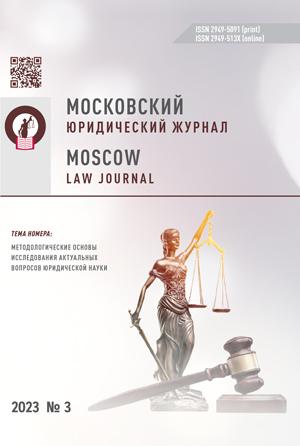
The edition is published 4 times a year. The journal “Moscow Juridical Journal” is included into the list of Higher Certifying Commission (НСС) in four specialities of Jurisprudence: 5.1.1. Theoretical-Historical Legal sciences (Jurisprudence), 5.1.2. Public Law (State Law) sciences (Jurisprudence), 5.1.3. Private Law (Civilistic) sciences (Jurisprudence), 5.1.4. Criminal Law sciences (Jurisprudence).
The printed journal publishes the articles of Russian and foreign scientists devoted to vital theoretical and practical problems of jurisprudence of Russia and foreign countries. Thus the editorial board and editorial council, firstly, create the opportunity for scientists and legal experts to exchange opinions; secondly, they strive to ensure the journal’s timely response to relevant law problems arising in practice.
The journal also covers scientific events, book reviews, information about personals and has a rubric “Rostrum for Young Scientists”.
The journal and law universities actively organize “round tables” and conferences.
The journal is addressed to scientists, lecturers, post-graduate students, doctoral candidates, employees of law enforcement bodies, judges, legal advisers, as well as to heads and specialists of bodies of state administration and local self-government.
Current issue
THEORETICAL AND HISTORICAL LEGAL SCIENCES
Aim. To identify the main ways of forming and spreading the spiritual and moral values of Russian citizens, and to develop proposals for improving the legal and regulatory framework for their protection. Strengthening moral guidelines plays a crucial role in ensuring the national security of every country. Despite the existence of such legislative initiatives, their practical effectiveness continues to be a subject of debate. In the context of globalization and the rapid development of the Internet, foreign ideas and lifestyles are infiltrating Russian society, posing a threat to national identity and cultural traditions. The key problems are the ambiguity of terminology and the variability of implementation at the regional level. Despite the efforts made to promote cultural education and patriotic upbringing in schools and universities, the lack of a systematic approach and monitoring of effectiveness weakens the impact of these measures. In today's world, where international relations are complicated by political and economic crises, social stability based on strong moral principles is particularly relevant.
Methodology. The methodological basis of the study was formed by the historical-legal, formal-legal, system-structural and comparative-legal methods. The historical-legal method allowed to trace the evolution of the concept "national security"; the formal-legal method – to analyse the content of the Decree of the President of the Russian Federation No. 809 and the Federal Law on Security (Article 2); the system-structural method – to determine the place of traditional values in the system of national security; the comparative-legal method – to identify the features of the Russian model.
Results. As a result, it can be stated that the officially recognised set of spiritual and ethical values of Russia, which guarantee the protection of national interests, includes the following non-material categories: human life and dignity of the individual, civil rights and freedoms, love for the motherland, active citizenship, devotion to the state, personal responsibility for the future of the country. Specific measures have been proposed to improve legislation.
Research implication. The author summarised the material on the influence of spiritual and moral values on citizenship, which notes that strengthening control and centralization of initiatives can contribute to stricter compliance with the legislative framework and deepening the positive effect of their application. The practical significance lies in the development of specific proposals for amending the Federal Law "On Security", creating a methodology for assessing the effectiveness of measures to strengthen traditional values, and improving the educational component of state policy.
PUBLIC LAW (STATE LAW) SCIENCES
Aim. To identify the essence and role of national projects as formally defined documents within the legal framework of strategic planning, to examine the legal force of acts establishing the content of national projects in order to clarify the legality of budget expenditures.
Methodology. General scientific methods (observation, comparison), logical methods (analysis, synthesis, generalization, induction, deduction), specific scientific methods (systemic, structural-functional), and specialized methods (formal-legal, legal hermeneutics) were used.
Results. The place and essence of national projects within the system of budget law sources is substantiated. National projects represent one of the key instruments for implementing the strategic development of the Russian Federation, ensuring the achievement of priority state policy goals. They cover various areas of public life, including the economy, social protection, education, healthcare, and innovative technologies. At the same time, national projects have a high degree of normative significance. Achieving project goals requires significant budgetary allocations and effective financial resource management, as budget risks can lead not only to significant budget losses but also to the failure to achieve the stated objectives. Legal measures are designed to ensure the achievement of national project goals on time and with the rational use of budgetary resources. National projects in the Russian Federation represent a complex legal phenomenon, combining elements of strategic management, program planning, and public law regulation. The possibility of classifying national projects as a special legal institution within the system of budgetary law sources is substantiated. This legal phenomenon occupies an intermediate position between regulatory legal acts and programmatic documents of public administration.
Research implications. Understanding the legal characteristics of national projects complements the doctrinal concept of the system of budgetary law sources and allows for the improvement of legislation in the area of budgetary regulation and financial control, as existing mechanisms do not always allow for the timely identification and mitigation of threats arising at various stages of national program implementation. Legally defining targeted expenditures serves as an effective financial control mechanism, as any attempts to divert or misuse national project funds are promptly identified by oversight bodies.
Aim. To study organizational, legal and conceptual features in the system of anti-terrorist protection of facilities and territories in the Russian Federation, to identify problems, development of recommendations on optimization of organizational and legal provision of anti-terrorist security.
Methodology. Analysis of the specifics of legal and conceptual provision of anti-terrorist security, as well as scientific publications in the field of optimization of national security, was conducted. The methods of modeling and practice-oriented analysis of relevant approaches to improve the organizational and legal framework for countering terrorism in the Russian Federation were used.
Result. The identified features of anti-terrorist security in the Russian Federation contributed to the formation of the hypothesis of anticipating signs indicating the formation of threat-forming factors for the anti-terrorist security of facilities and territories. This hypothesis is confirmed by the scientific development of the anti-terrorist function of the state and the technologies of direct and hidden impact on statehood, national identity, and the anti-terrorist consciousness of the population considered in the article. The value of the considered anti-terrorist function of the state is related to its usefulness for ensuring national security, that is, an element that captures completeness. In the article, this is an algorithm and a mechanism for conceptual optimization of the considered object and zonal regime in the following conditions of digitalization, and in general, the sustainable development of a modern social and legal state.
Research implications. The theoretical significance of the work lies in the objectivity of the scientifically based criteria of the considered field, which depend on the real and, to a lesser extent in practice, on the potential damage to the interests of the individual, society and the state. The author's approach, considered in the article, suggests focusing the attention of experts, developers of acts, and law enforcement officers on the importance of offensive measures in the field under consideration.
Aim. To analyse international cooperation projects in exploration to identify the new forms, methods and levels of international cooperation capable of bringing the Russian space program to a new level, provided that current space projects and key assets are preserved and developed.
Methodology. Analysis of forms of international cooperation of the Russian Federation in the field of space exploration was used as main research method was conducted. The most significant space projects implemented after the collapse of the USSR have been analysed. Classification of those projects by coverage (national, regional, global levels), and by subjects (public, private sector) was carried out.
Results. Options for development of the Russian national space project are proposed through the more active use of institutional models, and expansion of cooperation at the regional and global levels.
Research implications. Practical significance of this research lies in drawing attention of public and political actors to the topic of space exploration and the key role of the national space program in ensuring the technological sovereignty of the country. Necessity of revising the concept of international cooperation in space is shown, with emphasis on the regional projects, facilitating creation of the Russia's own technological block, based on the strong technological background and the unique location of the Baikonur cosmodrome. The importance of supplementing the space program with global-level projects is emphasized.
Aim. To identify the methods and criteria for establishing a balance of constitutional values in the context of the concept of solidarity using the example of the value of freedom of labor.
Methodology. A systems analysis and formal legal approach helped us to identify patterns in the interaction between the values of freedom of labor and freedom of economic activity. Using induction, generalising judicial practice and scholarly opinions, we drew conclusions about the methods, subjects, and criteria for establishing a balance of constitutional values.
Results. It is concluded that the balance of constitutional values is established not only by the Constitutional Court of the Russian Federation, but also by other judicial bodies, and, first and foremost, by the legislature, which defines the limits of judicial interpretation of legal norms. A balance consistent with the principles of fairness and proportionality, in a context of solidarity, cannot be reduced to "restrictions" on some constitutional values in favor of others and should promote cooperation among constituent entities.
Research implications. Methods, criteria for establishing a balance of constitutional values were identified, the peculiarities of their implementation in the context of the concept of solidarity were determined.
Aim. To identify the trends and features that have caused a serious transformation of public relations and the emergence of new challenges in the field of information security, and what impact these changes have on the field of facial security.
Methodology. Various methods were used in the article. such as analysis and synthesis, system analysis and others. The paper considers the impact of digital processing of personal data on the security of individuals and the state, which is especially important due to the aggravation of the geopolitical situation and the increasing number of attacks on the information infrastructure of our country, including information systems that process personal data. In addition, victims of fraudulent actions under the coercion of intruders can commit various illegal actions, including those directed at government agencies. All this, in turn, requires improvement of the state's approaches to the protection of personal data of individuals.
Results. The conclusion is proved that the digitalization of data processing about individuals has significantly affected public relations and has begun to affect not only individual rights, but also national security.
Research implications lies in the fact that the problems related to the need to protect the interests and security of the state in the field of personal data protection have been actualized, which comes to the fore due to the fact that constant leaks of information about individuals not only create tension in society and negatively affect the business climate, but also affect the level of protection of human rights and national security. The
Aim. To provide a theoretical understanding and justification of the constitutional doctrine of the social state in constitutional law.
Methodology. The main content of the study is an analysis of legal doctrine in relation to the doctrine of the social state and its place in constitutional law. The author analyses and summarises the positions established in the scientific literature on this issue.
Results. Based on the study, it was established that the constitutional doctrine of the social state – a specialized legal term denoting the doctrine of the social state – expresses the process of formation of the value component of the state structure and the subsequent consolidation of these ideas in law and possesses certain properties. The constitutional doctrine of the social state is a specific system of views, prescriptions, and ideas that are scientifically substantiated, officially recognized, and meet the needs of society and individuals in the social sphere; An effective state social policy, ensuring a decent life, and other social rights.
Research implications. The essence of the doctrine of the social state, which has certain properties, determines the modern social policy of the Russian Federation and human needs in the social sphere, is revealed. The content of the doctrine of the social state is connected not only with law, but also with the moral and ethical attitudes prevailing in society.
Aim. To examine the doctrinal foundations of the principles of compulsory pension insurance from a historical perspective – from the Soviet period, when social security law began to be recognised as a distinct branch of law, to the current state of Russian legislation.
Methodology. The content of the article is based on an analysis of legislative acts and other regulatory documents.
Results. It is demonstrated that the principles of the universality of social security, social solidarity and social justice are not revealed in isolation, but within the system of constitutional norms, legislation on insurance pensions and state pension provision, as well as in the works of scholars in the field of social security law. It is argued that the Soviet doctrine laid the conceptual foundations for the modern pension model, although the compulsory pension insurance system in its current form took shape during the post-Soviet period. It is concluded that universality determines the scope of pension protection, solidarity determines the public-law model of financing and redistribution of pension risk, and fairness determines the criteria for the lawful differentiation of pension rights.
Research implications. The results of the study can be used in the development of new regulatory documents relating to pension insurance.
PRIVATE LAW (CIVILISTIC) SCIENCES
Aim. Тo identify the features of the legal status of cryptocurrencies in foreign and Russian practice in order to justify the need for their full integration into domestic legislation.
Methodology. The analysis of researchers' views on the civil legal nature of digital assets is presented. The sources are analysed, including foreign regulatory experience, as well as the dynamics of Russian legislation in terms of mining, taxation, and experimental legal regimes. The article summarises the judicial practice and positions of the Constitutional Court of the Russian Federation on the protection of the rights of owners of digital currencies. Comparative legal, historical-legal, system-logical and judicial-legal methods were used in the framework of this research.
Results. Тhe analysis showed that the Russian Federation forms a balanced regulatory model, recognising digital currency as property for tax and criminal purposes. However, it has been established that the absence of cryptocurrencies in the basic list of objects of civil rights in the Civil Code of the Russian Federation creates legal uncertainty and risks of unjustified refusal of judicial protection.
Research implications. Рroposals have been formulated to supplement Article 128 of the Civil Code of the Russian Federation with the term «digital currencies». The proposed revision will make it possible to definitively determine their legal nature as objects of civil rights, ensure the uniformity of court decisions and guarantee the protection of the rights of bona fide purchasers.
Aim. To consider different approaches of law enforcement practice in the field of property liability of an educational organisation for harm caused to a minor.н
Methodology. The study used the formal-legal method, the method of comparative legal analysis, and systematisation. The use of the formal-legal method helped to identify ambiguous approaches in determining the conditions and scope of liability of an educational organization (individual entrepreneur) for causing property damage and harm to the life or health of a minor. The use of the method of comparative legal analysis and systematisation helped to interpret evaluative concepts that influence the emergence of liability for compensation of harm.
Results. The content, grounds for the occurrence and implementation of claims for compensation for non-pecuniary damage in relation to harm to minors or minors are considered in detail.
Research implications. The proposals and conclusions contained in this article can serve as a basis for further research on the property liability of educational organizations for harm caused to minors.
УГОЛОВНО-ПРАВОВЫЕ НАУКИ (ЮРИДИЧЕСКИЕ НАУКИ)
Aim. To identify problematic aspects of criminal regulation of cryptocurrency theft to determine the areas of improvement of the relevant institution.
Methodology. The work used comparative legal, formal legal, systematic methods, as well as methods of analysis, synthesis, induction, deduction and generalization.
Results. It has been established that the cryptocurrency, despite its immaterial nature and lack of clear regulatory consolidation, has the characteristics of property and can be considered as an object of theft. The key problems of qualifying the theft of cryptocurrencies have been identified and directions for improving domestic legislation in this area have been proposed.
Research implications. Proposals have been formulated to improve the criminal law regulation of the theft of cryptocurrencies. The theoretical material on the legal nature of cryptocurrencies.
Aim. To substantiate the methodological relevance of using the image of Luka from Maxim Gorky's play "The Lower Depths" as a didactic model in training cadets of departmental educational institutions in specialized methods of recruiting various categories of citizens as confidential informants; to identify the psychological mechanisms of trust formation within this legal institution as embodied in the character's behavio, and to determine their significance for the professional training of operative officers.
Methodology. Theoretical and comparative analysis; literary and discourse analysis of the character's communicative strategies; psychological interpretation of the literary text drawing on the concepts of C. Rogers, A. Maslow and P. Ekman; specific methods of operative-investigative psychology.
Results. It is established that Luka's communicative behaviour is characterised by psychological patterns extensively studied in the scholarly literature: unconditional positive regard, adaptive communication strategies, emotional resonance, and positive reframing of life situations. The artistic environment of the doss-house is shown to function as a model of a criminal micro-environment marked by a high level of distrust towards the outside world. Four stages of psychological influence in the recruitment of confidential informants are identified, and their correlation with the literary character's behavioural strategies is demonstrated.
Research implications. The proposed approach enriches the methodological framework for teaching operative-investigative disciplines through the incorporation of narrative analysis of classical literary works. The identified principles of communicative influence may serve as the basis for practical training sessions aimed at developing cadets' foundational knowledge of establishing psychological contact with potential confidential informants in order to effectively address the tasks of crime detection and investigation.
Aim. To examine the subjective side of the crime, in particular, its element, such as the motive for committing a crime, using the example of Article 155 of the Criminal Code of the Russian Federation.
Methodology. The main content of the study is an analysis of the approaches of scientists to the disclosure of the content of the category "motive of crime", as well as the classification of possible motives for committing a crime, an analysis of the views of researchers is given. The main focus is on the motives for disclosing the secrets of adoption.
Results. The position of the authors, who propose to abandon the construction of the compositions of the Special part of the Criminal Code of the Russian Federation using the phrase "base motives", replacing it with the lexical construction "personal motives", is supported.
Research implications. The problems of determining the motivational component of the subjective side of the corpus delicti have been updated, and the prospects for improving legislation have been considered.

ISSN 2949-513X (Online)